BCMG Insights · Strategic Investment Research
Food Is Becoming Strategic
Why Japan's trading houses, a one-dollar fertilizer plant, and the next supply-chain repricing all point at Australia.
September 2026
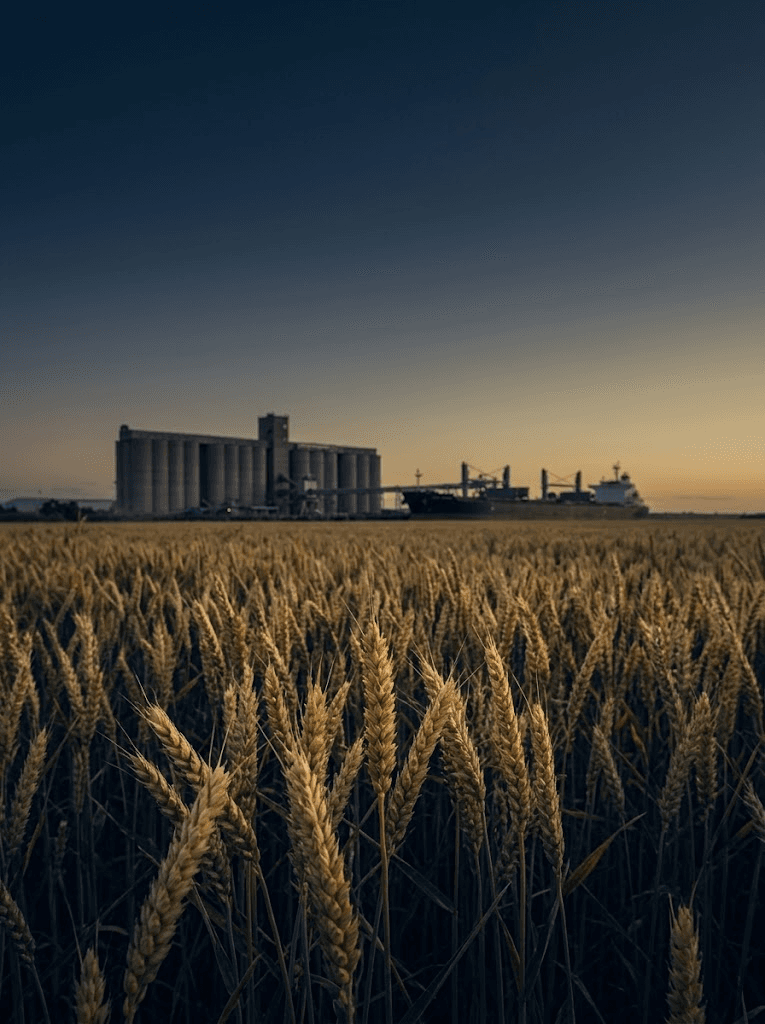
Grain, not just minerals — the same export infrastructure the First Wave built is where the food story runs through too.
Contents
- 01The Thesis in One Page
- 02The Food System, in Numbers
- 03What JPMorgan Actually Said
- 04From Efficiency to Resilience
- 05Japan's Food Anxiety Is Measurable
- 06The Playbook Already Exists: The Trading Houses
- 07The Map: Where Japanese Capital Already Sits
- 08Phosphate: The Chokepoint at the Start of the Chain
- 09The Dollar Plant: Phosphate Hill
- 10Where the Model Applies, and Where It Doesn't
- 11What Would Prove Us Wrong
- 12What Changes for Investors
- 13Conclusion: The Next Strategic Resource Is Grown, Not Mined
01
The Thesis in One Page
The Takeaway
Food is moving from a commodity story to a security story, the same journey energy made after 1973 and critical minerals made after 2010. Japan has already made the move official: food security was written into law in 2024, and fertilizer sits on the same critical-products list as semiconductors and rare earths. The capital that acts on that anxiety, the trading houses, has spent decades building food positions. Australia sits where the anxiety and the capital meet.
There are investment themes that begin as a cyclical story and gradually become something much bigger. We think food security is one of them.
JPMorgan's recent research brought the issue into focus. Its report, Food Security Is National Security: A Compounding Storm, warns that successive shocks across war, weather, warehousing, water and waste could keep global food inflation elevated into the first half of 2027, roughly doubling from 2.8 per cent to around 5 per cent (JPMorgan, as reported August 2026). Behind the forecast sits a live catalyst: NOAA declared an El Niño advisory in August, and gives a 69 per cent probability that this event becomes the strongest since records began in 1950 (NOAA CPC).
But for us, the interesting question is not whether food inflation reaches a particular number next year. It is what happens when governments begin to treat food the way they have learned to treat energy and critical minerals: as a matter of economic security rather than procurement.
We have watched this movie twice. Energy security after the 1973 oil shock converted Japanese strategic anxiety into the capital that built Australia's coal, iron ore and LNG export economy. Supply-chain security after China's 2010 rare earth embargo is now converting the same anxiety into the critical-minerals framework we described in Australia and Japan: The Second Wave. Each time, the sequence was the same. A shock exposed a dependency. The dependency was reclassified from a commercial matter to a security matter. And capital that had been unavailable became available, on different terms, with different patience.
Food is earlier in that sequence than minerals. That is precisely why it is interesting.
Japan has already made the reclassification official. In May 2024 it revised the Basic Law on Food, Agriculture and Rural Areas for the first time in twenty-five years, elevating food security to a core objective of national policy (MAFF). Fertilizer sits alongside semiconductors, storage batteries and critical minerals on the list of eleven specified critical products under the 2022 Economic Security Promotion Act (Cabinet Order No. 394, 20 December 2022). And on 7 August 2026, three weeks before this report, Japan's food self-sufficiency rate printed at 37 per cent on a calorie basis, down after four years at 38 and equal to its all-time low (MAFF).
The capital most likely to act on that anxiety is the same capital that acted on it in 1963 and 2011: the sogo shosha. And the place where their food strategies, Australia's agricultural endowment, and the world's most concentrated agricultural input all intersect is the subject of this report.
02
The Food System, in Numbers
The Takeaway
The aggregate numbers look calm. The structure underneath does not. Prices are drifting up from a comfortable base, the inputs are concentrated to minerals-like levels, and the buyer of last resort for calm, Japan, has just printed its worst self-sufficiency number on record.
Before the argument, the scale. Every figure below is from a government, multilateral or primary corporate source, detailed in the notes.
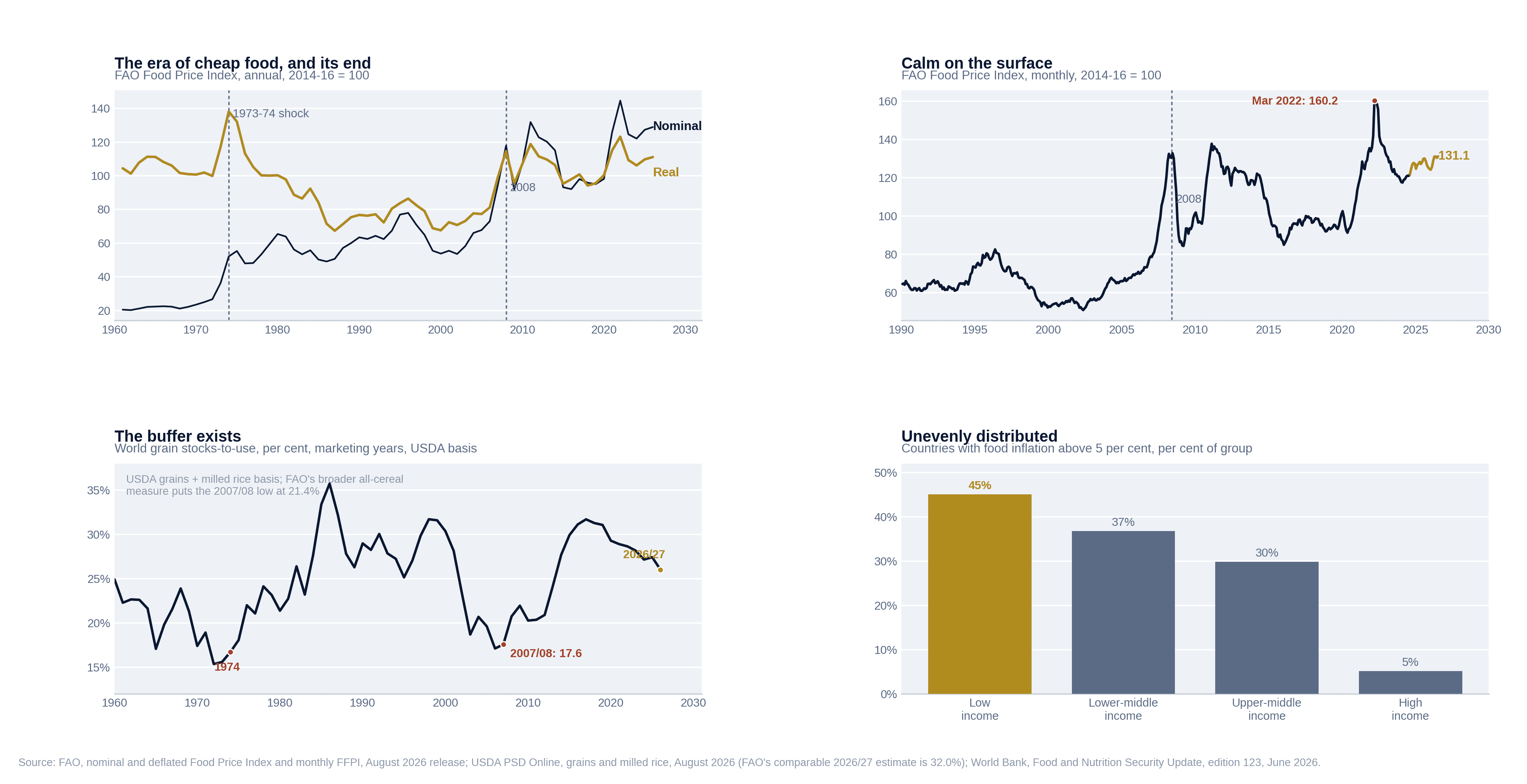
- 131.1. The FAO Food Price Index in July 2026, up 1.0 per cent on a year earlier and 18 per cent below its March 2022 all-time peak of 160.2 (FAO). Calm on the surface.
- 32.0 per cent. The global cereal stocks-to-use ratio forecast for 2026-27, against 30.5 per cent in the 2021-22 squeeze and a record low of 21.4 per cent in 2007-08 (FAO). The buffer exists. It is the inputs, not the grain, where the stress sits.
- 45 per cent. The share of low-income countries running food inflation above 5 per cent, against 5 per cent of high-income countries (World Bank, June 2026). Food stress is already here; it is just unevenly distributed.
- 23 countries. The number that imposed food export restrictions at the peak of the 2022 crisis, covering roughly 17 per cent of globally traded calories (IFPRI). The precedent that matters: when food gets scarce, trade gets political.
- $781 per tonne. DAP phosphate fertilizer in July 2026, still within 18 per cent of its 2022 crisis peak while urea has fallen 57 per cent from its peak (World Bank). Nitrogen has normalised. Phosphate has not.
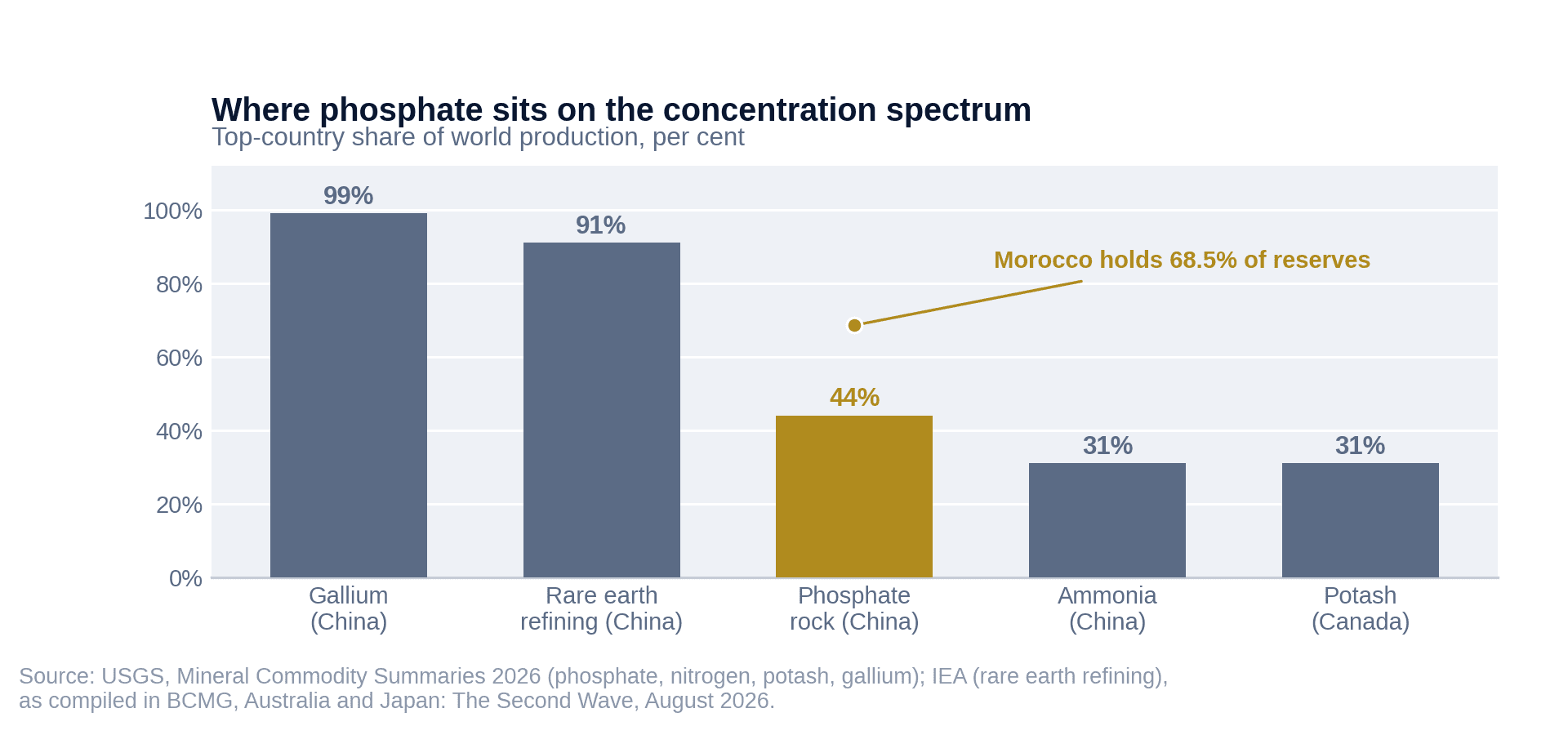
- 44 per cent and 68.5 per cent. China's share of world phosphate rock production, and Morocco's share of world reserves (USGS, 2026). Compare gallium at 99 per cent and rare earth refining at 91 per cent: phosphate is not the most extreme chokepoint we have written about, but it is the one attached to everyone's dinner.
- 37 per cent. Japan's food self-sufficiency on a calorie basis, FY2025, matching its all-time low, against a government target of 45 per cent by FY2030 (MAFF, 7 August 2026).
- ~100 per cent. Japan's import dependence for phosphate and potash, the two fertilizer inputs that cannot be synthesised from air. 72 per cent of Japan's ammonium phosphate imports come from China (MAFF).
- One dollar. The headline price at which Australia's only ammonium phosphate plant changed hands on 30 June 2026 (Dyno Nobel). Section 9 is about why that number should stop the reader.
03
What JPMorgan Actually Said
The Takeaway
The bank's framework is five compounding shocks, not one crisis. We think the forecast matters less than the reclassification: a major global bank now files food under national security. That is how repricings start.
The report, led by senior global economist Nora Szentivanyi, argues that successive shocks since COVID have compounded, eroding food production capacity and keeping food price pressures elevated into 2027 (JPMorgan, as reported August 2026). The framework is five words: war, weather, warehousing, water, waste.
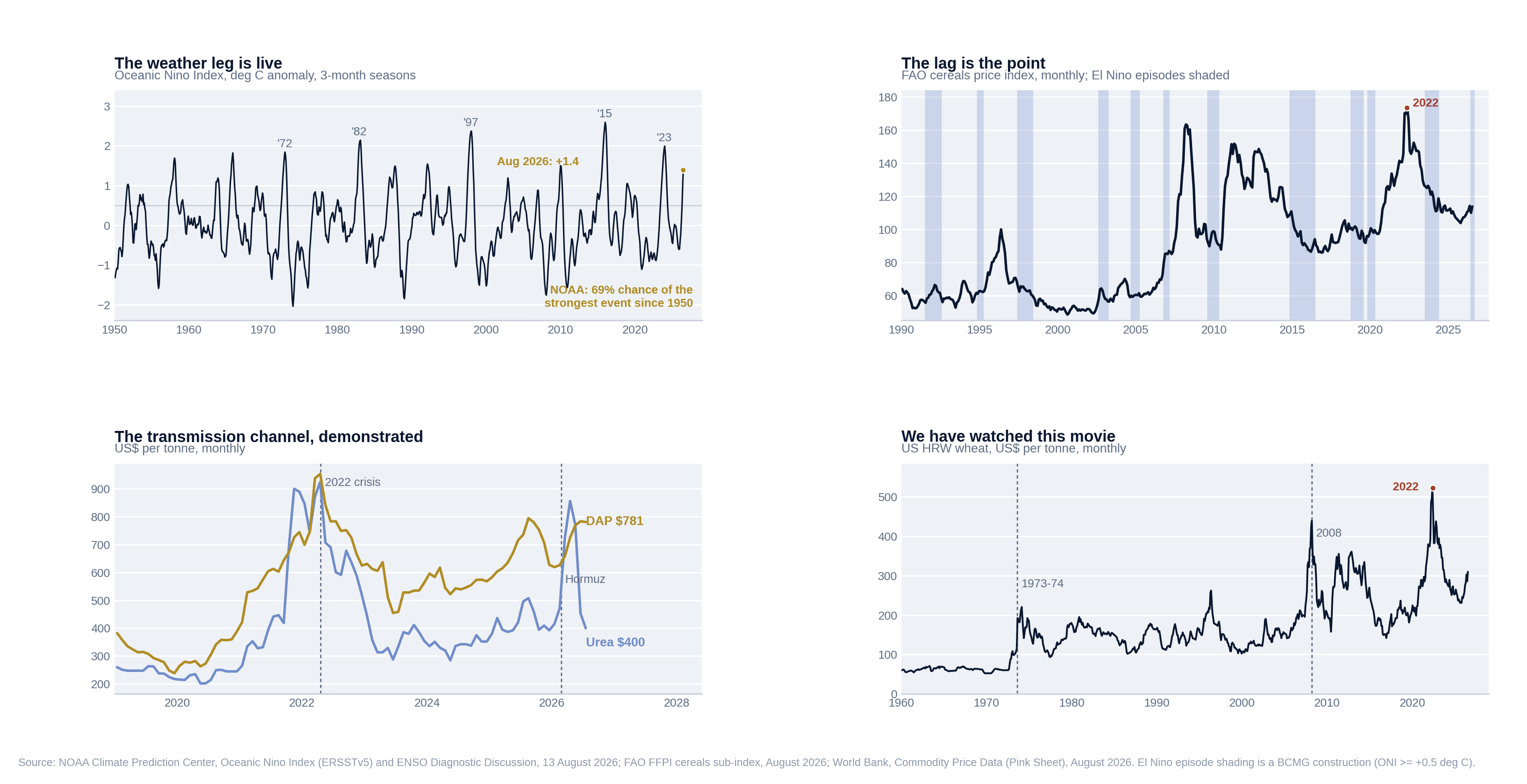
The mechanics behind the forecast are worth taking seriously. Global food inflation, running at 2.8 per cent in the first half of 2026, is projected to roughly double to around 5 per cent annualised by the first half of 2027. A historic El Niño alone has typically added around 0.7 percentage points to global food inflation; combined with an energy shock, the bank estimates the effect could roughly double. And the critical detail for timing: agricultural impacts lag the oceanic peak by six to twelve months, which is why food markets can look calm immediately before a supply problem arrives (JPMorgan, as reported).
Two things give the warning more weight than the average bank note.
First, the weather leg is no longer hypothetical. NOAA placed an El Niño advisory in effect in August 2026, with the Niño-3.4 anomaly already at +1.4°C, a greater than 90 per cent chance of a very strong event this winter, and a 69 per cent chance of the strongest event since records began in 1950 (NOAA CPC, August 2026). We would note plainly that this is a probabilistic forecast, made in the season when ENSO forecasts carry known limitations. But it is the official reading, not a tail scenario we have selected.
Second, the fertilizer leg has a demonstrated transmission channel. JPMorgan's earlier work flagged that the Persian Gulf supplies more than 36 per cent of the world's traded urea, and nitrogen prices rose 25 to 50 per cent within weeks of the Strait of Hormuz disruption this year before retracing (JPMorgan, April 2026, as reported). A fertilizer shock does not appear at the supermarket; it appears in planting decisions, then in yields, then in prices, quarters later.
Our interest, however, is not in re-underwriting the bank's inflation forecast. It is in the title. When the largest bank in the United States files food under national security, it is doing to food what a decade of policy work did to semiconductors and critical minerals: moving it from the commodity desk to the security desk. Capital allocation follows that move. It always has.
04
From Efficiency to Resilience
The Takeaway
The food system was optimised for cost for forty years. Every shock since 2020 has revealed what that optimisation quietly sold: redundancy. Reliable supply is beginning to command the premium that cheap supply used to.
For decades, the global food system was built the way all late-twentieth-century supply chains were built. Produce where costs are lowest. Carry minimal inventory. Source inputs globally. Move product through the cheapest logistics available. It worked, and world food prices in real terms spent most of three decades falling.
But the same optimisation created dependencies, and the past five years have exposed them in sequence. COVID broke the logistics. The invasion of Ukraine broke the grain and fertilizer trade, driving the FAO index to its all-time peak and pushing twenty-three countries into export restrictions covering a sixth of traded calories (FAO; IFPRI). The 2025-26 Middle East escalation put more than a third of the world's traded urea behind a chokepoint (JPMorgan, as reported). And a potentially historic El Niño is now developing against that backdrop (NOAA).
Each shock produced the same policy response: a country somewhere decided that food, or an input to food, was too important to leave to the market. India restricted rice. Indonesia restricted palm oil. China restricted phosphate, and has kept restricting it, in successive rounds, since 2021 (Reuters; Profercy). The United States added phosphate and potash to its critical minerals list in November 2025 (Federal Register).
This is the same migration we documented in minerals. The cheapest supply is no longer automatically the most valuable supply. Reliable supply commands a premium. Diversified supply commands a premium. Domestic processing commands a premium. That premium is precisely what strategic capital exists to fund, and what purely commercial capital consistently underprices.
05
Japan's Food Anxiety Is Measurable
The Takeaway
This is not a forecast about Japanese behaviour. The law changed in 2024, fertilizer joined the critical-products list in 2022, and the self-sufficiency number that drives the politics just matched its worst-ever reading. The anxiety is on the statute book.
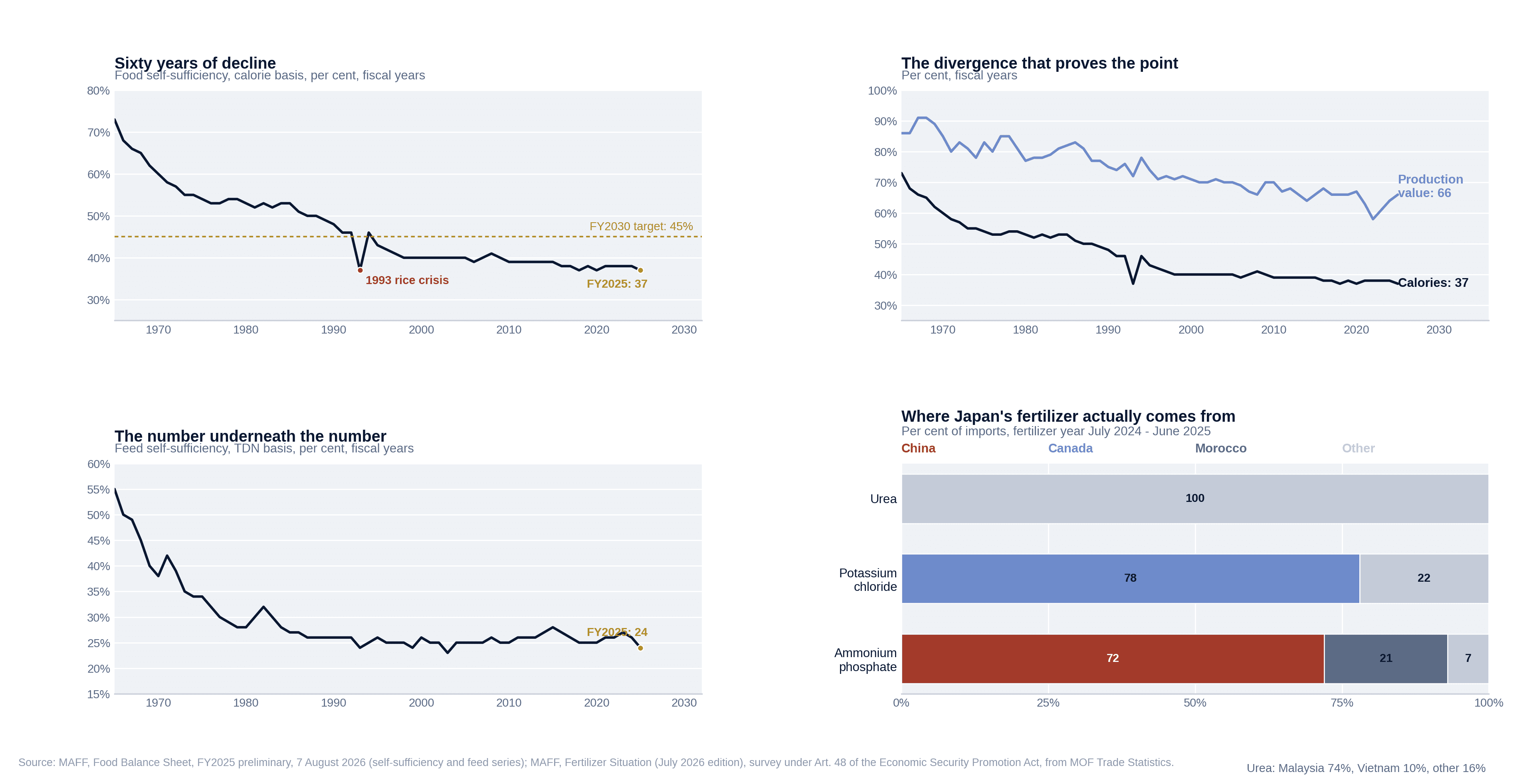
Japan imports its dinner the way it imports its energy. The food self-sufficiency rate, the share of calories consumed that are produced domestically, was 37 per cent in FY2025, down from four straight years at 38 and equal to the all-time low first touched in FY1993 (MAFF, 7 August 2026). Feed self-sufficiency, the number underneath the number, is 24 per cent, which means even the domestic egg and the domestic steak are substantially imported at one remove (MAFF). The government's own target is 45 per cent by FY2030, adopted in the April 2025 Basic Plan (MAFF). The gap between 37 and 45 is not going to be closed by exhortation.
The legal machinery has been rebuilt around that gap.
In May 2024, the Diet passed the first substantive revision of the Basic Law on Food, Agriculture and Rural Areas since 1999, explicitly establishing food security as a core objective and adding provisions on stable supply and import diversification (MAFF; Japan Times). Twenty-five years of policy continuity ended because the assumption underneath it, that world food markets would always sell to the highest bidder, stopped looking safe.
Two years before that, the Economic Security Promotion Act designated fertilizer one of eleven specified critical products, alongside semiconductors, storage batteries, machine tools and critical minerals (Cabinet Order No. 394, 20 December 2022). Under the Act, Japan is stockpiling: the target is three months of demand by FY2027, and as of late 2025 potassium chloride had reached target while the ammonium phosphate stockpile remained short of it (MAFF, as reported). A country does not stockpile fertilizer for the same reason it does not stockpile semiconductors, unless it has concluded the supply can be interrupted.
The dependency justifying that conclusion is stark. Japan imports effectively all of its phosphate and potash, the two nutrients that come from rock rather than air, and around 97 per cent of its urea. And the concentration inside the import bill is the detail that should be familiar to readers of our previous report. 72 per cent of Japan's ammonium phosphate comes from China (MAFF). China has restricted phosphate exports in successive rounds since 2021, and as of March 2026 restricts them again, in a measure covering an estimated 50 to 80 per cent of its export volumes (Reuters). Japan has seen this exact structure before, in rare earths, in 2010. It knows how the story goes.
Even the Growth Strategy, the July 2026 cabinet decision whose seventeen strategic fields and ¥370 trillion investment ambition we analysed in The Second Wave, carries the food theme: field sixteen is FoodTech, framed around production technology, plant factories and land-based aquaculture (Cabinet Secretariat). Food enters Japan's industrial strategy through the technology door rather than the farming door. That detail matters for where the capital will land.
06
The Playbook Already Exists: The Trading Houses
The Takeaway
The instrument that converted Japan's energy anxiety into Australian mines in the 1960s, and its minerals anxiety into Lynas in 2011, has been quietly running the same playbook in food for a decade. Nobody reprices the shosha for it. Their food businesses are still valued as trading, not as strategic infrastructure.
Our previous report described the mechanism at length, so here it is in one paragraph. When Japan decides a dependency is strategic, the response is not a communique; it is a chequebook, and the chequebook is usually held by a trading house. Mitsui funded the Moura mine in 1963 before Australia had an export coal industry. Sojitz and JOGMEC funded Lynas in 2011 before the West had a rare earth industry. Customer, capital and offtake arrive together, early, and absorb the risks conventional capital prices worst.
The food version of that playbook is already running. It has simply not been reclassified yet, which is why it is still cheap to observe.
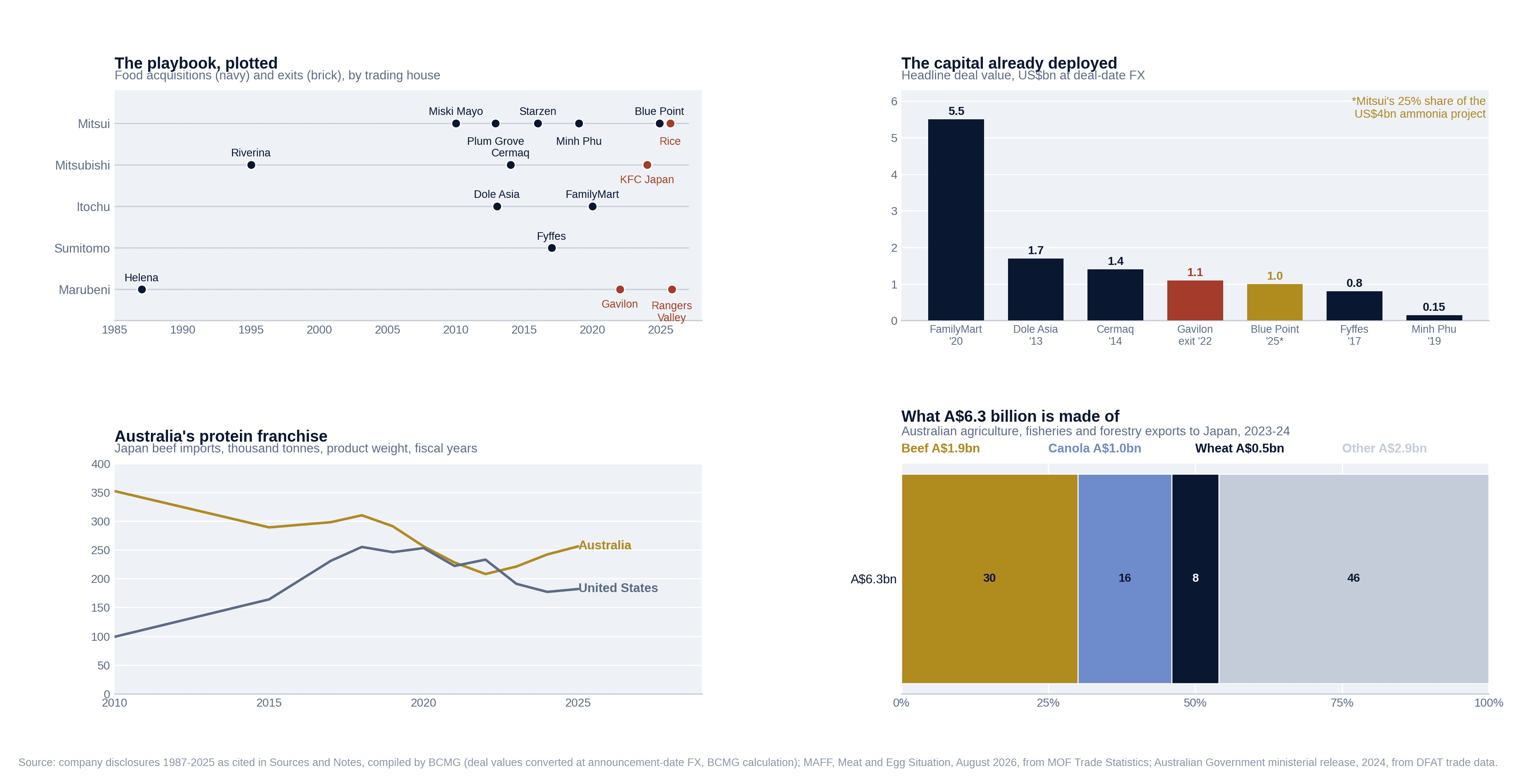
The evidence is not a strategy slide. It is a list of transactions. Mitsubishi paid roughly US$1.4 billion for Cermaq, one of the world's largest salmon farmers, in 2014, and has owned Brisbane-based Riverina, a grain trader and Australia's leading independent stockfeed manufacturer, outright since 1995 (Mitsubishi Corporation). Mitsui holds 25 per cent of the Miski Mayo phosphate mine in Peru alongside Mosaic, and 25 per cent of Plum Grove, a Perth-based grain accumulator and exporter. In 2019 it took 35 per cent of Vietnam's Minh Phu, one of the world's largest shrimp producers. And in April 2025 it committed roughly US$1 billion for a quarter of the US$4 billion Blue Point low-carbon ammonia project with CF Industries (40 per cent) and JERA (35 per cent), the feedstock end of the nitrogen fertilizer chain (Mitsui; Mosaic; CF Industries). Itochu paid US$1.69 billion for Dole's worldwide packaged foods and Asian fresh produce businesses in 2013 and took FamilyMart private in 2020 as the consumer end of a food value chain. Sumitomo paid €751 million for Fyffes, the banana and fresh produce group, in 2017. Marubeni owns Helena, one of the two largest agricultural-input distributors in the United States (company disclosures throughout).
Honesty requires the other side of the ledger, and it is instructive rather than damaging. Marubeni sold its Gavilon grain platform to Viterra in 2022 for US$1.1 billion and sold the Rangers Valley cattle operation in 2025; Mitsubishi sold down KFC Japan and restructured Lawson in 2024; Mitsui divested its rice trading unit, Mitsui & Co. Agri Foods, to Toyota Tsusho in 2025 (company disclosures). The shosha are not accumulating food assets indiscriminately. They are doing what they did to their metals books in the 2010s: concentrating capital in the layers with pricing power, inputs, protein, logistics and the consumer interface, and exiting undifferentiated trading in the middle. Selective repositioning is what strategic allocation looks like. Indiscriminate buying is what a bubble looks like.
The market values none of this as strategic. The trading houses are priced, still, substantially as resource-cyclical conglomerates. How much LNG? How much copper? How much iron ore? We think investors will soon be asking a different question, the one almost nobody asks now. What strategic food systems do they control? And what would those systems cost to replicate the day after food is repriced the way minerals were?
07
The Map: Where Japanese Capital Already Sits
The Takeaway
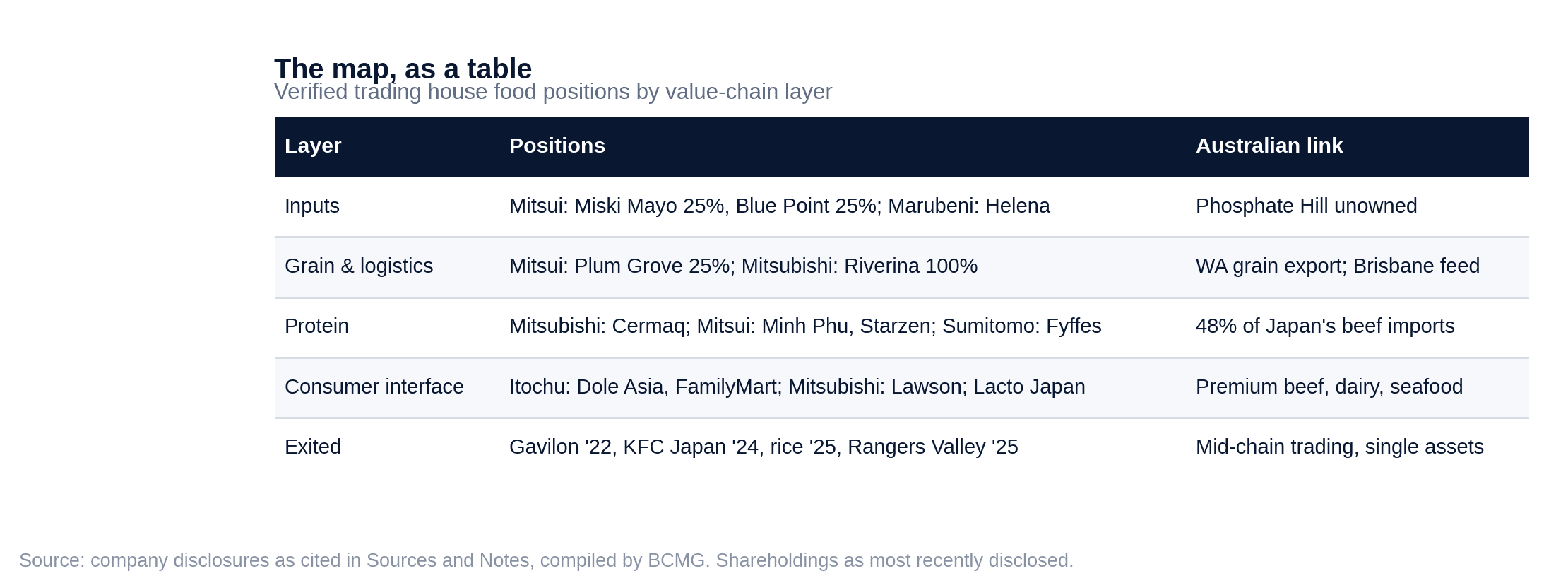
Follow the capital, not the headlines. Plotted on the value chain, the shosha positions cluster exactly where a security buyer would put them: inputs, grain logistics, protein systems and the Asian consumer interface. Australia appears at every layer.
Rather than asking whether food prices rise next year, we ask where sophisticated Japanese capital has already chosen to sit. Plotted against the value chain, the positions form a pattern.
Inputs. Mitsui's Nutrition and Agriculture unit spans crop protection through Certis, seeds, fertilizers and biostimulants, phosphate rock through Miski Mayo, and now ammonia feedstock through Blue Point (Mitsui). Marubeni's Helena sits at the North American farm gate, and Marubeni retained Gavilon's fertilizer distribution business even as it sold the grain (Marubeni). Upstream of the farm is where the chokepoints are, and the capital knows it.
Grain and logistics. Mitsui's Plum Grove accumulates and exports Western Australian grain into Asia. Mitsubishi's Riverina procures and exports Australian grain and oilseeds while manufacturing feed, connecting the grain layer to the protein layer inside one business (company disclosures). The asset is not the wheat. It is the accumulation, storage and export infrastructure the wheat must pass through.
Protein. Cermaq in salmon, Minh Phu in shrimp, Riverina in feed, Starzen in Japanese meat processing, Fyffes and Dole in produce. Protein is where Asian food demand grows as incomes rise, and it is the most feed-intensive, logistics-intensive layer of the system, which is to say the layer where integrated capital wins.
The consumer interface. FamilyMart, Lawson, and the downstream specialists. Here we would highlight one smaller name as a pure expression of the theme: Lacto Japan (TSE 3139), which imports roughly a third of Japan's dairy ingredients and is building an Asian cheese manufacturing platform, with a new Singapore plant entering production through 2026 and reaching full scale in the year to November 2027 (company disclosures). Not a trading house, and valued at around ¥34 billion, it is the kind of specialised mid-cap the market has not yet connected to the security theme at all.
Australia appears at every layer of this map: Plum Grove and Riverina in grain, the feedlot and beef trade in protein, and, at the input layer, the subject of section 9. Australia's food and agricultural exports to Japan were A$6.3 billion in 2023-24, its third-largest agricultural market (DFAT). Australia supplies roughly 48 per cent of Japan's imported beef and 95 per cent of its imported barley in MY2021/22 (USDA FAS). The relationship is already deep. The question is whether it gets reclassified.
08
Phosphate: The Chokepoint at the Start of the Chain
The Takeaway
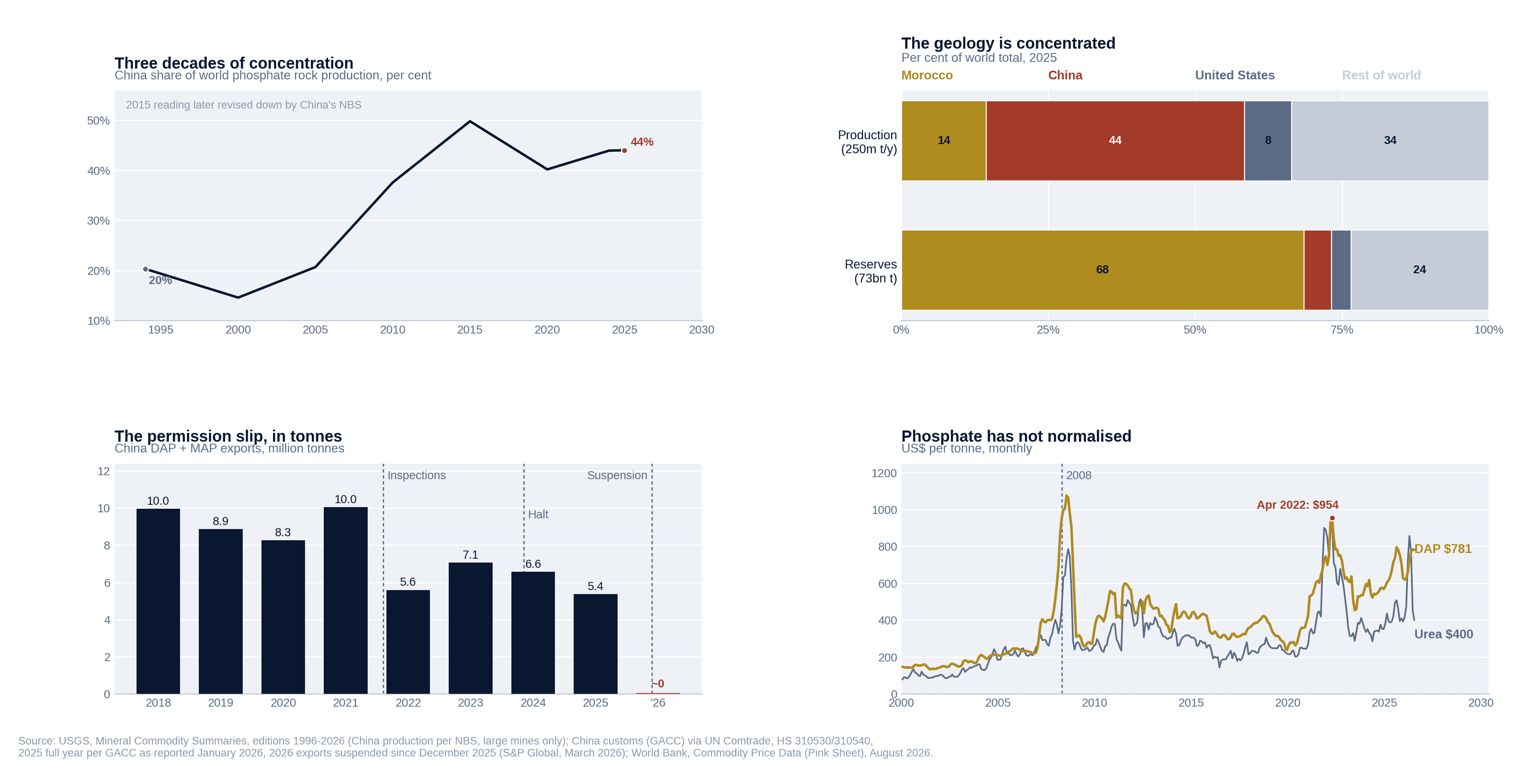
Phosphorus cannot be synthesised, substituted or bypassed; it is mined or it is absent. Morocco holds 68.5 per cent of reserves, China 44 per cent of production, and China has restricted exports in successive rounds since 2021. To a Japanese planner this chart looks exactly like rare earths in 2009.
Food is grown, but its inputs are mined. Of the three primary nutrients, nitrogen is made from air and natural gas, and its constraint is energy. Potash and phosphate come out of the ground, and phosphate is the one with no backstop: no substitute, no synthesis route, no recycling industry at scale. Phosphorus is essential to every crop grown anywhere, and it comes from geology.
The geology is concentrated. China produces 44 per cent of the world's phosphate rock; China, Morocco and the United States together produce two-thirds (USGS, 2026). Reserves are more concentrated still: Morocco holds roughly 50 of the world's 73 billion tonnes, 68.5 per cent, most of it in Western Sahara (USGS). For comparison with the materials in our previous report: less extreme than gallium at 99 per cent or rare earth refining at 91 per cent, but comparable to the potash triopoly, and attached to a market, food, that every government on earth answers for politically.
And the concentration is being used. China has run export inspections, quotas and outright halts on phosphate fertilizers in successive rounds since October 2021: quotas from 2021, a halt in late 2023, a 6.5-million-tonne quota regime for 2024. Then, in March 2026, against the backdrop of the Hormuz disruption, came unpublished restrictions estimated by industry analysts to cover 50 to 80 per cent of Chinese export volumes, extended at least through August 2026 (Argus; Profercy; Reuters). This is the phosphate market's version of the gallium licence regime: not an embargo, a permission slip.
Prices carry the signature. Urea, the nitrogen product, has retraced 57 per cent from its 2022 peak. DAP, the phosphate product, trades at $781 a tonne, within 18 per cent of its crisis peak, and near its 2026 high even as the energy shock faded (World Bank, July 2026). The market is telling you which nutrient has the structural problem.
Washington noticed: phosphate and potash joined the US critical minerals list in November 2025 (Federal Register). Tokyo noticed earlier: fertilizer went onto the critical-products list in 2022, and the stockpile Japan is now building remains short of its three-month ammonium phosphate target, in a market where 72 per cent of supply comes from the restricting country (MAFF).
For a Japanese planner the pattern recognition is immediate, because it is the 2010 rare earth structure with a fifteen-year head start: extreme single-country dependence, demonstrated willingness to restrict, no domestic option, and a friendly resource-rich ally one shipping lane away. Which raises the obvious question. What does the friendly ally's phosphate industry actually look like?
09
The Dollar Plant: Phosphate Hill
The Takeaway
Australia's only ammonium phosphate plant sold for one dollar on 30 June 2026, with the seller paying the buyer to take it and two governments lending $160 million to keep it alive. Strategic scarcity and commercial worthlessness, priced on the same asset, on the same day. That gap is the entire Second Wave thesis in a single transaction.
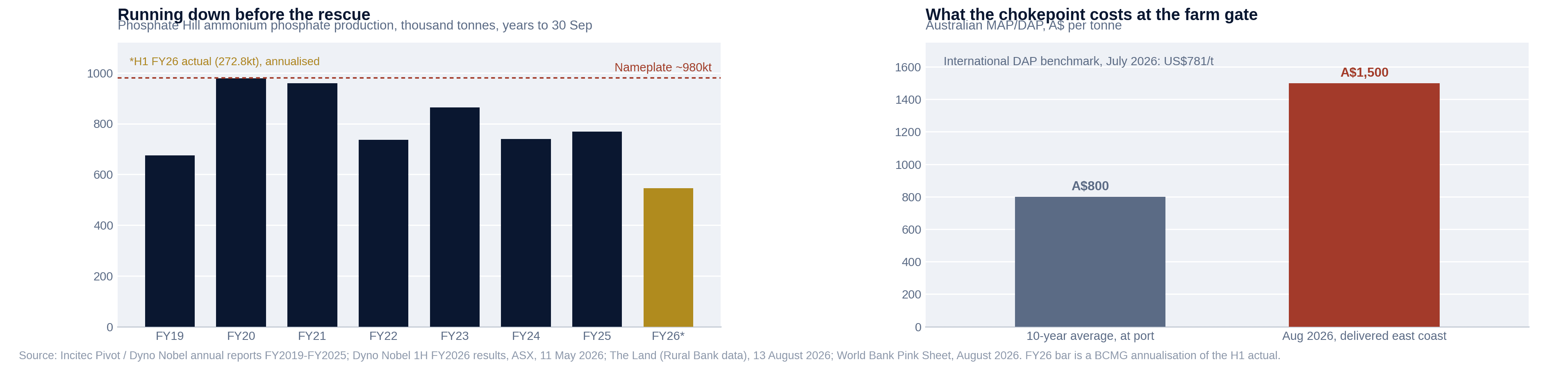
In north-west Queensland, near Mount Isa, sits Phosphate Hill: an integrated mine and plant with nameplate capacity around 800,000 to one million tonnes of ammonium phosphates a year, and the only facility in Australia that makes them (Argus; Grain Central). A country of vast phosphate geology, 800 million tonnes of identified rock per USGS accounting, has exactly one plant that converts any of it into the fertilizer its farmers actually spread.
Here is what happened to it, in sequence, and every date matters.
In 2024 its owner, Incitec Pivot, tried and failed to sell its fertilizer business to Indonesia's PKT, then told the market its working assumption was closure. In 2025 the company renamed itself Dyno Nobel, sold the Incitec Pivot Fertilisers distribution brand to Ridley, and in October set a public deadline: a buyer by 31 March 2026, or orderly closure by 30 September 2026. In March 2026 a buyer appeared: Ryowa II GPS, a subsidiary of the private Brisbane group Mayfair Australia. The price was one dollar. On 30 June 2026 the sale completed, on terms that tell you everything: Dyno Nobel paid the buyer $50 million at completion, funds $125.9 million of site rehabilitation, and retains up to $150 million of deferred consideration only if the plant performs. The next day, the federal and Queensland governments announced a joint $160 million loan facility to modernise the plant and cushion sulphur costs. Roughly 540 jobs continued (Dyno Nobel ASX releases; Argus; Industry Queensland).
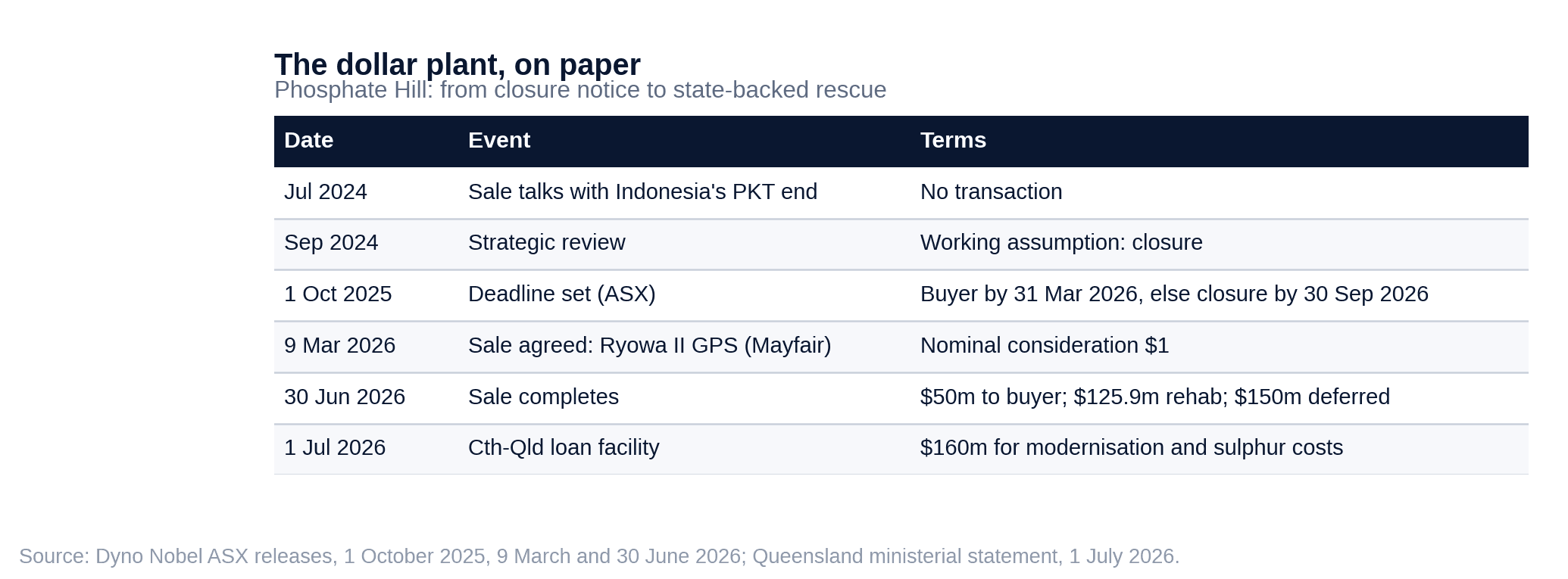
Sit with the arithmetic. The seller valued the asset so far below zero that it paid to be rid of it. Two governments, within twenty-four hours, valued its survival at $160 million of public credit. Both were right. Commercially, a remote, ageing, sulphur-hungry plant competing with restricted-but-resumable Chinese exports is a liability. Strategically, the only domestic source of a critical input, in a world where the dominant exporter now issues permission slips, is infrastructure. The one-dollar price is what it looks like when a strategic asset is valued by purely commercial capital. The $160 million loan is what it looks like when the state notices. The gap between those two numbers is the entire opportunity set this report describes.
Readers of our previous report will recognise the shape, inverted. Wagerup was value already flowing through existing Australian infrastructure, switched on by strategic capital: gallium nobody had a reason to recover until security of supply became the reason. Phosphate Hill is the same logic running in reverse: strategic capability that existed for a quarter of a century, switched off by the absence of strategic capital, and caught at the last moment by an improvised rescue. One shows what the Second Wave model builds. The other shows what happens where it has not yet arrived.
And the Japanese angle is conspicuous by its absence. Japan stockpiles ammonium phosphate against a Chinese supply it explicitly distrusts. Australia's only ammonium phosphate plant just sold for a dollar, to a buyer with no fertilizer operating history, sustained by taxpayer credit. The country that invented arriving early, with customer, capital and offtake together, at Moura in 1963 and at Lynas in 2011, was nowhere in this transaction. Either the model has a blind spot, or the reclassification of food has simply not caught up with the reclassification of minerals. We think it is the latter. That timing gap is what an investor gets paid for noticing.
We would add one discipline note, because our own framework demands it. Phosphate Hill's economics are hard, and no framing changes that: remote logistics, imported sulphur, gas supply, an ageing asset. The rescue has not ended the difficulties. Output is running well below nameplate amid gas disruptions, China has halted sulphuric acid exports, and a 56-day maintenance shutdown is already scheduled for early 2027 (trade press, August 2026). Strategic relevance does not repeal any of that, which is exactly why the commercial price was a dollar. The investable lesson is not that this plant is a bargain. It is that Australia's agricultural-input layer is so far from being priced as strategic that its centrepiece traded at scrap value ninety days before a global bank declared food a national security problem.
10
Where the Model Applies, and Where It Doesn't
The Takeaway
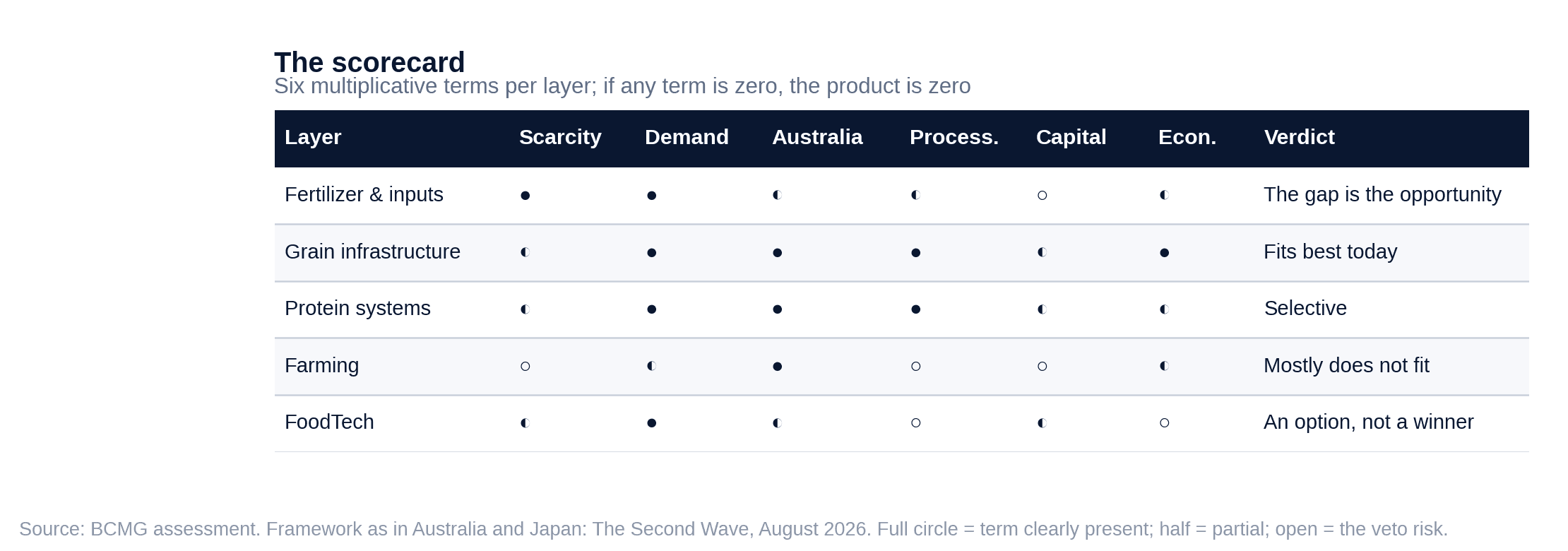
Five layers, five different verdicts. Inputs and logistics fit the strategic model best; growing things, mostly, does not. The discipline from our minerals work carries over intact: strategic capital can pay for resilience, it cannot repeal a cost curve.
Fertilizer and inputs fit the model best. Concentrated supply, demonstrated weaponisation, designated critical status in Japan, negligible strategic premium in asset prices. This is where minerals were in roughly 2015.
Grain infrastructure fits well. The commodity is competitive and re-routable; the accumulation, storage, rail and port capacity it must pass through is not. Australia's grain logistics already carry Japanese capital through Plum Grove and Riverina, and infrastructure earns its keep in every price scenario, which is what a security buyer wants.
Protein systems fit selectively. Australia's 48 per cent share of Japanese beef imports is a strategic relationship by any definition, and integrated feed-to-protein systems have the switching costs strategic capital likes. But protein is exposed to the cost curve like any agriculture, and Marubeni's exit from Rangers Valley is a reminder that even shosha capital walks away when the economics disappoint.
Farming itself mostly does not fit. Land is politically sensitive to foreign ownership in both directions, returns are weather-levered, and nothing about strategic demand fixes a drought. The First Wave did not buy Australian coal seams retail; it funded the mines and took the offtake. Expect the food version to rhyme: capital into processing, logistics and offtake, not paddocks.
FoodTech is the wildcard, and the one Japan has formally chosen: field sixteen of the Growth Strategy, framed around plant factories and land-based aquaculture (Cabinet Secretariat). We treat it the way we treated hydrogen in the previous report, as a strategic option rather than an assumed winner, and we would be suspicious of anyone who treats it otherwise in 2026.
The multiplicative discipline from our minerals framework transfers without modification: strategic scarcity × Japanese demand × Australian advantage × processing capability × strategic capital × commercial economics. If any term is zero, the product is zero. Phosphate Hill just demonstrated the final term's veto power at a price of one dollar.
11
What Would Prove Us Wrong
The Takeaway
Five falsifiers, held in the open. The two we watch most closely: El Nino fizzling into a benign 2027 harvest, and Japanese capital conspicuously failing to show up in food inputs within two years of the law telling it to.
A thesis without a falsification mechanism is a mood. Ours fails if:
- The weather leg collapses. NOAA's 69 per cent historic probability is a forecast, not a fact, and ENSO forecasts made mid-year have humbling track records. Two benign harvests would take food inflation, and the urgency, out of the story. The structural chokepoints would remain, but the repricing would wait years.
- China normalises phosphate exports durably. The entire input-security case rests on demonstrated willingness to restrict. A multi-year return to unrestricted Chinese DAP exports at 2019 volumes would compress the strategic premium to zero, and DAP's price would converge back toward urea's path. Watch the quota announcements each spring.
- Japanese capital does not show up. The sharpest test. The law changed in 2024, the stockpile targets bite in FY2027, and the shosha have the balance sheets. If, by 2028, there is no material Japanese strategic investment in food inputs or agricultural infrastructure in allied countries, then food anxiety is not converting into capital the way energy and minerals anxiety did, and the parallel we have drawn fails. Lynas came within eighteen months of the 2010 shock. The clock is running.
- Self-sufficiency politics turns inward. Japan could answer 37 per cent with domestic subsidy rather than offshore investment, protecting rice paddies instead of funding supply chains. The Basic Plan's production targets lean that way; the trading house incentives lean the other. If MAFF budgets balloon while outbound food investment stalls, the inward reading is winning.
- The trading houses keep selling. Our reading of Gavilon and Rangers Valley is disciplined repositioning. The bear reading is simpler: the smartest food investors in Japan are net sellers of exactly the assets we say are about to be repriced. If the next three years bring more Cermaq-scale exits than entries, the bear reading was right and ours was not.
12
What Changes for Investors
The Takeaway
Stop asking what food prices do next year. Start asking which food-system assets would be hardest to replace, and who is quietly accumulating them while they are priced as boring.
For investors in the trading houses, the question changes shape. The market prices the shosha on resources and, since Buffett, on capital discipline. Nobody, as far as we can tell, prices the food books as strategic infrastructure. On the day food is repriced the way minerals were, the positions described in section 7, salmon systems, grain ports, input distribution, phosphate equity, become the kind of assets that cannot be assembled at any price on short notice. The option is being given away.
For investors in Australian agriculture, the lesson of both waves is to own the bottleneck, not the commodity. The obvious way to play food security is to buy food producers. We think that is too simple. The better questions are the ones a security planner would ask. Who controls fertilizer? Who controls grain storage and export terminals? Who controls feed, processing and cold chain? Who connects Australia with Asia? The First Wave's fortunes were made in infrastructure and offtake, not in digging. The food equivalent is storage, ports, processing and inputs, the layers where Phosphate Hill just demonstrated the gap between commercial and strategic value can reach one hundred and sixty million dollars and one dollar respectively on consecutive days.
For companies, the Second Wave playbook transfers directly. The strategic question is not can we sell food to Japan. It is can Japanese strategic demand help us build supply-chain infrastructure that would otherwise be unfinanceable. The Moura structure, customer, capital and contract arriving together before the industry exists, has not been tried on Australian agricultural inputs in this cycle. Somebody will try it first.
And for all three, the same warning we ended with last time. Strategic capital changes who carries risk. It does not abolish it.
13
Conclusion: The Next Strategic Resource Is Grown, Not Mined
The Takeaway
Twice now, a Japanese shock has been converted through capital into an Australian industry. Food has entered the same sequence: the reclassification is already on the statute books, in Tokyo and Washington alike. What has not yet arrived is the capital, and the Moura moment for food has not happened.
Twice now, the same sequence has rebuilt part of the Australian economy. A shock exposes a Japanese dependency. The dependency is reclassified from procurement to security. Capital arrives on new terms, early, patient and attached to offtake, and Australian resources that could not otherwise be developed get developed. Oil in 1973 gave Australia its coal, iron ore and LNG economy. Rare earths in 2010 gave it Lynas, and is now giving it the critical-minerals framework we described three weeks ago.
Food has entered the first stage of the same sequence. The shocks have arrived in succession since 2020, and a historic El Niño may be about to add another. The reclassification is underway: on Japan's statute book since 2022 in fertilizer and 2024 in food itself, on the US critical minerals list since November, and now in the research notes of the largest American bank. What has not yet arrived is the capital. The trading houses hold the positions, the balance sheets and the sixty-year-old playbook, but the Moura moment for food, the transaction that announces the reclassification to everyone, has not happened.
That is what makes this the interesting stage. In minerals, the equivalent window, between China's 2010 embargo and the world noticing what Lynas had become, lasted about a decade, and the investors who used it did not need to predict anything. They needed only to notice that the anxiety was already law, the capital already existed, and the assets were still priced as boring.
The assets are still priced as boring. Australia's only phosphate plant just sold for a dollar. The FAO index is calm. The shosha food books trade as trading. And Japan just printed 37 per cent.
Food is becoming strategic. Phosphate sits at the start of the chain. Australia sits in the middle of the opportunity. And the trading houses, once again, are the capital to watch.
That is the thesis. The falsifiers are in section 11. We will be watching the same five things you should.
14
Sources and Notes
Show full sourcing and methodology notes
How to read the sourcing. Every factual claim in the body carries a short source tag in brackets naming the publishing body. The full citation for each, with edition and release date, appears below, grouped by theme. Where a figure is our own calculation from published data, we say so.
The JPMorgan report. Food Security Is National Security: A Compounding Storm, JPMorgan Global Research, led by Nora Szentivanyi, published circa 10-14 August 2026. The report itself is not public; all figures are as reported by press including ZeroHedge (15 and 18 August 2026) and IBTimes UK, and we attribute them accordingly. Verbatim quotes limited to those carried in press: the compounding-shocks framing and the six-to-twelve-month El Niño lag. Global food inflation 2.8 per cent H1 2026 rising to circa 5 per cent H1 2027; El Niño historically adding circa 0.7pp to global food CPI, potentially doubled by an energy shock; Persian Gulf supplying more than 36 per cent of globally traded urea and nitrogen prices up 25-50 per cent post-Hormuz: same press coverage, the fertilizer figures deriving from the bank's April 2026 note. The USDA 12.3 per cent grocery figure circulating alongside press coverage is a USDA forecast, not JPMorgan's, and we do not use it.
Weather. El Niño advisory, Niño-3.4 anomaly +1.4°C, greater than 90 per cent probability of a very strong event and 69 per cent probability of the strongest since 1950: NOAA Climate Prediction Center, ENSO Diagnostic Discussion, 13 August 2026. IRI/CPC plume corroborating. We note these are probabilistic forecasts issued in a season of known ENSO forecast limitations, and that 2025-26 winter was a La Niña.
Food system data. FAO Food Price Index 131.1, July 2026 (2014-16=100), against the March 2022 peak of 160.2 on the current revised series: FAO, August 2026 release. Cereal stocks-to-use 32.0 per cent for 2026-27, with 30.5 per cent in 2021-22 and the 2007-08 low of 21.4 per cent: FAO Cereal Supply and Demand Brief, July 2026, and historical FAO releases. Food inflation exceeding 5 per cent in 45.0 per cent of low-income and 5.1 per cent of high-income countries: World Bank Food and Nutrition Security Update, edition 123, June 2026. Export restrictions peaking at 23 countries and circa 17 per cent of traded calories, May 2022: IFPRI food export restrictions tracker. Fertilizer prices, July 2026 monthly averages: urea US$400.0/t (peak US$925.0, April 2022), DAP US$781.3/t (peak US$954.0), MOP US$396.5/t (peak US$562.5): World Bank Commodity Price Data (Pink Sheet), August 2026 and May 2022 editions.
Phosphate market structure. China 110,000kt of 250,000kt world phosphate rock production in 2025 (44.0 per cent, our calculation); Morocco reserves 50 of 73 billion tonnes (68.5 per cent, our calculation, Morocco figure inclusive of Western Sahara per long-standing USGS practice); Australia production 2,500kt and reserves 800 million tonnes (120 million tonnes JORC-equivalent): USGS, Mineral Commodity Summaries 2026, phosphate rock chapter, February 2026. Potash and nitrogen comparisons: same publication, respective chapters. Phosphate and potash added to the US Final 2025 List of Critical Minerals: Federal Register, 90 FR 50494, 7 November 2025. Chinese export restrictions: customs inspection regime from October 2021 and successive quota rounds per Argus and Profercy as reported in trade press; March 2026 unpublished restrictions covering an estimated 50-80 per cent of export volumes per Reuters reporting; extension through August 2026 per trade press. We could not verify a precise 2025 quota volume and do not quote one.
Phosphate Hill. Capacity circa 800,000-1,000,000t/y ammonium phosphates and status as Australia's only MAP/DAP plant: Argus, July 2026; Grain Central, September 2024. Sequence: Incitec Pivot-PKT talks ended July 2024; strategic review with closure assumption, September 2024; rename to Dyno Nobel, April 2025; distribution business sold to Ridley, September 2025; buyer-by-31-March-2026-or- closure-by-30-September-2026 deadline, ASX statement 1 October 2025; sale agreement with Ryowa II GPS Pty Ltd, subsidiary of Mayfair Australia Corporation, for nominal consideration of $1, announced 9 March 2026; completion 30 June 2026 with Dyno Nobel paying a $50m completion payment, funding $125.9m rehabilitation, and retaining up to $150m deferred consideration; circa 540 workforce continuing: Dyno Nobel ASX releases of 9 March and 30 June 2026. $160m joint Commonwealth-Queensland loan facility announced 1 July 2026: ministerial statements as reported. The 14 July 2026 Incitec Pivot Fertilisers stakeholder update noting continuing offtake from Phosphate Hill is issued by the distribution business now owned by Ridley Corporation, not by the plant's owner, and Argus reports that offtake was under renegotiation with Mayfair; we therefore do not cite it as evidence of the plant's strategic position.
Japan. Food self-sufficiency 37 per cent calorie basis FY2025, down from 38 and equalling the record lows of FY1993, FY2018 and FY2020, production-value basis 66 per cent: MAFF, 7 August 2026. FY2030 targets of 45 and 69 per cent: Basic Plan, Cabinet decision 11 April 2025. Feed self-sufficiency 24 per cent: MAFF. Revision of the Basic Law on Food, Agriculture and Rural Areas passed 29 May 2024, the first substantive revision since 1999, establishing food security as a core objective: MAFF; Diet record. Fertilizer among the eleven specified critical products designated under the Economic Security Promotion Act (Act No. 43 of 2022) by cabinet decision of 20 December 2022, Cabinet Order No. 394 of 2022, promulgated 23 December 2022: Cabinet Office, economic security supply-chain programme; EPRS briefing, 2023. Stockpiling targets of three months by FY2027, potassium chloride at target and ammonium phosphate short of target as of late 2025, per Japanese industry reporting of MAFF data; import dependence circa 100 per cent for phosphate and potash, circa 97 per cent for urea; ammonium phosphate imports 72 per cent from China, 21 per cent Morocco: MAFF fertilizer situation reports, 2025-26 editions. FoodTech as field sixteen of the seventeen strategic fields: Cabinet Secretariat, Japan Growth Strategy, Cabinet decision 21 July 2026.
Trading house positions. All from company disclosures: Mitsubishi's Cermaq acquisition, NOK8.88bn (circa US$1.4bn), completed November 2014; Riverina wholly owned since 1995. Mitsui: Miski Mayo phosphate 25 per cent (from 2010; Mitsui's 25 per cent per its Annual Securities Report FY3/2013; Mosaic holds the remaining 75 per cent since acquiring Vale's 40 per cent in 2018, per Mosaic 10-K filings); Plum Grove 25 per cent (agreement December 2012); Minh Phu 35.1 per cent, circa US$150m (2019); Starzen 16.39 per cent (2016); Blue Point ammonia JV, Louisiana (CF Industries 40 per cent, JERA 35 per cent, Mitsui 25 per cent), FID April 2025, project circa US$4bn: CF Industries and JERA releases, 8-9 April 2025. Itochu: Dole worldwide packaged foods and Asia fresh produce businesses, US$1.685bn (announced September 2012, completed April 2013; Dole and Itochu releases); FamilyMart privatisation (2020). Sumitomo: Fyffes €751m (2017). Marubeni: Helena (since 1987); Gavilon grain sold to Viterra for US$1.125bn base (completed October 2022) with the fertilizer business retained; Rangers Valley sold to Stanbroke (announced October 2025). Mitsubishi's KFC Japan exit and Lawson restructuring (2024); Mitsui's divestment of Mitsui & Co. Agri Foods (rice trading) to Toyota Tsusho, announced 14 May 2025 and completed 2 June 2025: Toyota Tsusho release. Lacto Japan: circa 35 per cent share of Japanese dairy-ingredient imports, revenue ¥182.8bn FY11/2025, Singapore plant phasing into production through 2026 with full contribution from FY11/2027: company IR materials.
Australia-Japan food trade. Agriculture, fisheries and forestry exports to Japan A$6.3bn in 2023-24, Japan the third-largest market: Australian Government ministerial release. Australia circa 48 per cent of Japan's beef imports (2024): USDA FAS Tokyo, Livestock Annual 2025. Australia supplied 95 per cent of Japan's barley imports in MY2021/22: USDA FAS Tokyo, Grain and Feed Annual, GAIN report JA2023-0021, 21 March 2023.
Note on BCMG constructions. The layered value-chain framing in sections 7 and 10, the parallel drawn between phosphate and the 2010 rare earth episode, and the characterisation of trading house repositioning are BCMG analysis, not published findings of the sources above. The scorecard disciplines applied are those of Australia and Japan: The Second Wave, BCMG Insights, August 2026.
This report is intended for research and informational purposes only. It does not constitute financial advice, an offer or solicitation to buy or sell securities, or a guarantee of investment outcomes.
BCMG Insights · Strategic Investment Research · September 2026
Have a Question on Food Security?
Speak with our senior team about fertilizer, agricultural infrastructure and the Japan-Global corridor.
Get in Touch